Don't Make This Common Fall Mistake: How Autumn Yard Care Shapes Your Spring Landscape Success
Autumn yard care strategy is not mainly about making a property look tidy before winter. The more important job is to decide what should be removed, what should remain, what the soil needs, and which plants need protection before cold, wind, drought, freezing, and thawing can expose weak points. A yard that looks immaculate in November can still enter winter poorly prepared if the cleanup removes useful organic material, mulch is applied at the wrong time, roots go into freezing weather dry, or late-season work stimulates vulnerable new growth.
The practical goal is therefore not maximum cleanup. It is appropriate preparation. That distinction changes the order of work: inspect first, manage debris intelligently, assess soil and moisture, protect vulnerable plants, and only then put tools and systems away for winter.
Quick Autumn Yard Care Checklist
Use this checklist as a self-audit before the first sustained freeze. It is deliberately organized around decisions rather than a generic list of chores.
- Inspect before cutting: identify diseased plant material, damaged branches, exposed roots, compacted areas, standing water, and plants that are unusually dry.
- Manage leaves according to quantity: mulch a manageable layer into turf when conditions allow; collect excessive coverage so grass is not smothered.
- Separate healthy and questionable debris: do not automatically compost material carrying significant disease or pest problems.
- Check soil before amending it: if plants show no evidence of a nutrient or pH problem, avoid adding materials simply because it is fall.
- Water vulnerable plants while the soil is unfrozen: give particular attention to new plantings and evergreens during dry autumn weather.
- Mulch with purpose: use an appropriate organic mulch around roots, but keep trunks and plant crowns clear.
- Delay certain protective coverings: for perennials and bulbs, winter mulch may be better after soil begins to freeze rather than immediately after fall cleanup.
- Protect exposed young plants: inspect young trunks and shrubs for likely browsing, wind, or winter-desiccation problems.
- Winterize irrigation: if freezing conditions threaten irrigation lines, follow the system manufacturer's winterization procedure rather than leaving water trapped in vulnerable components.
- Clean tools last: remove soil and plant residue, dry metal tools, and store equipment only after the living landscape has received its final inspection.
1. Start With Debris, But Do Not Treat Every Leaf as Waste
Fall cleanup often goes wrong because “clean” is confused with “bare.” Leaves are organic material, and finely shredded leaves can return nutrients and organic matter to turf and soil. The decision should depend on where the leaves are, how much has accumulated, whether the material is healthy, and whether the surface underneath still receives enough air and light.
For turf, a useful rule is simple: if a light, finely shredded layer disappears into the lawn without forming a dense blanket, it may be manageable; if leaves accumulate faster than they break down and begin obscuring most of the grass, collect them. University of Minnesota Extension guidance describes leaf mulching as a way to return nutrients and improve soil structure, while also warning that excessive leaf residue can become detrimental. r1
This creates an important either/or decision:
The U.S. Environmental Protection Agency identifies leaves, grass clippings, yard trimmings, and other organic materials as potential compost inputs, while noting that diseased or pest-infested plant material should not simply be added to a typical backyard pile. r2
Removing every fallen leaf, standing perennial stem, and layer of organic material can eliminate useful habitat and soil cover. Conversely, leaving dense leaf mats over turf or diseased plant residue throughout the yard can create problems. The right autumn cleanup is selective, not absolute.
2. Inspect the Soil Before You Start “Fixing” It
Autumn is an excellent time to observe the condition of the ground because the landscape shows the results of the previous growing season. Look for bare patches, persistent puddling, hard compacted surfaces, exposed roots, erosion channels, unusually weak turf, and planting beds that drain too slowly or dry too quickly.
The mistake is to treat every visible problem as a fertilizer problem. A thin lawn may be affected by shade, traffic, poor drainage, inappropriate mowing, compaction, or excessive leaf cover. A shrub with weak growth may have a root-zone problem rather than a nutrient deficiency. Adding amendments without knowing the underlying condition can waste effort and sometimes create a new imbalance.
If you suspect a nutrient or pH problem, test first; if there is no evidence of such a problem, prioritize physical soil conditions and moisture management before adding amendments. Oregon State University Extension recommends soil testing and notes that compost can be used where appropriate to improve soil conditions. r3
Think of autumn soil preparation as diagnosis rather than decoration. A spring landscape depends on roots entering the new growing season in a workable soil environment. That may mean correcting compaction, improving organic matter over time, managing drainage, or simply avoiding unnecessary disturbance.
3. Protect Roots, Not Just What You Can See Above Ground
One of the most overlooked autumn tasks is protecting the root zone. The trunk and branches are visually obvious, but roots can be more vulnerable to drying, freezing, and rapid temperature changes. University of Minnesota Extension notes that roots are less hardy than stems and that mulch and adequate soil moisture can moderate soil temperatures and reduce injury. r4
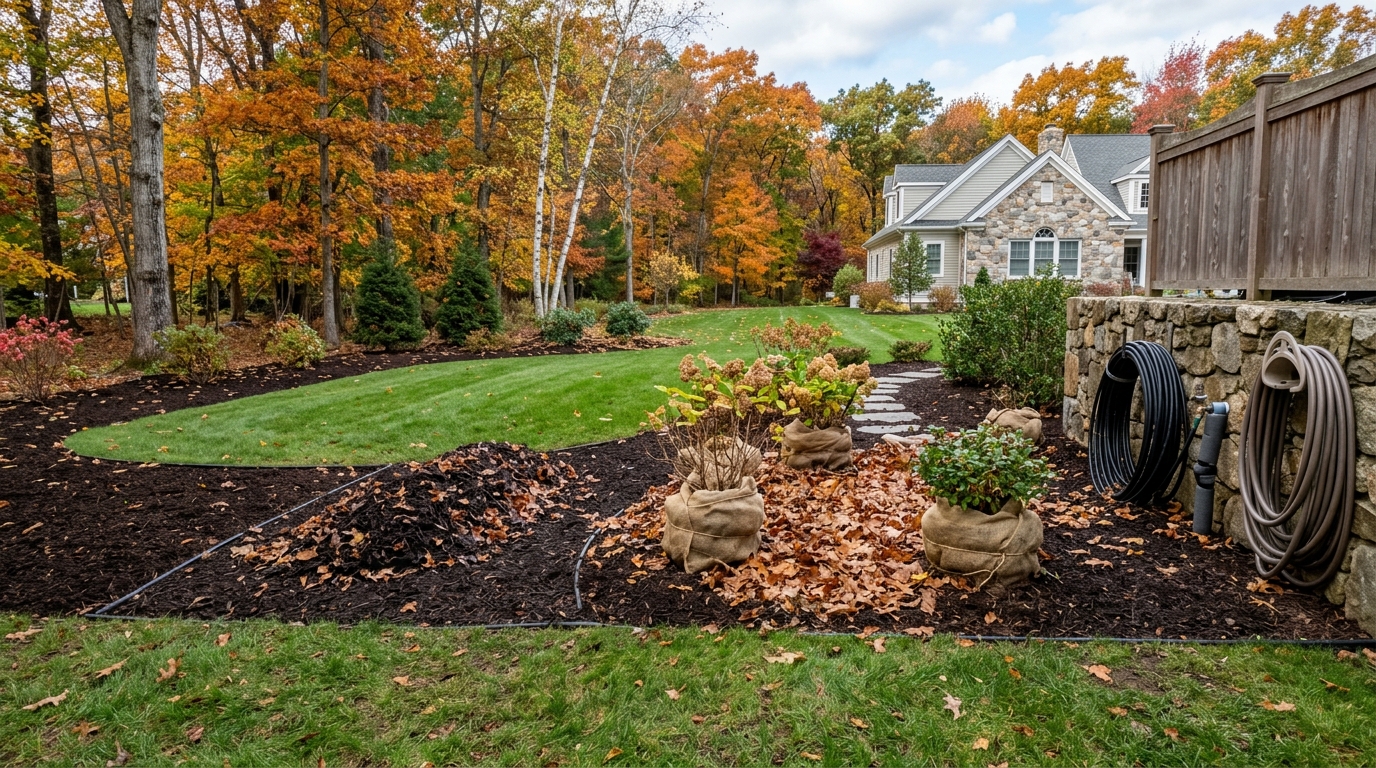
For newly planted trees and shrubs, this matters even more. Their roots are still establishing beyond the original planting area, so an apparently healthy canopy does not prove the root system is ready for winter.
Organic mulch can help conserve moisture, moderate temperature swings, and reduce competition from turf. But mulch should form a broad, shallow protective zone rather than a mound against the trunk. University of Minnesota Extension recommends leaving the root flare bare and warns that excessively deep mulch can reduce oxygen around roots and create other problems. r5
If the planting is new and the autumn has been dry, prioritize root-zone moisture and correctly applied mulch; if the planting is established and the soil is already adequately moist, do not assume more water or more mulch automatically provides more protection.
4. Water Before Freezing—But Know When to Stop
Watering in late autumn is a conditional task, not a calendar ritual. The question is whether the plant needs water and whether the ground can still absorb it.
Evergreens deserve particular attention because they retain foliage through winter and can lose moisture during cold, windy conditions. Newly planted trees and shrubs also require more consistent watering while their roots establish. University of Minnesota Extension emphasizes regular watering for new plantings and recommends directing water toward the root zone rather than the trunk. r6
Illinois Extension describes fall and winter watering as a balancing act: water during dry conditions while the ground remains unfrozen, but stop supplemental watering once the ground freezes because roots cannot absorb water through frozen soil. r7
This produces a useful decision sequence:
- Check recent rainfall and soil moisture.
- Identify vulnerable plants. New trees, shrubs, and exposed evergreens deserve more attention than dormant annuals that will not return.
- Water deeply when the soil is dry and unfrozen.
- Stop when the ground freezes.
The trade-off is that watering everything on the same schedule can be as unhelpful as neglecting everything. Saturated soils can deprive roots of oxygen, while dry soil going into winter can increase stress. Autumn maintenance is therefore a matter of reading conditions rather than following a single universal date.
5. Use Winter Protection at the Right Time
Winter protection is often described as an installation task: put down mulch, wrap vulnerable plants, and finish the job. Timing is more nuanced.
For perennials and spring-flowering bulbs, University of Minnesota Extension advises waiting until the soil begins to freeze before applying protective mulch. The reason is that an early insulating layer can encourage growth before winter has properly arrived, leaving plants vulnerable to later cold. Protective mulch also helps moderate repeated freeze-thaw cycles that can lift plants out of the soil. r8
That means a fall cleanup day may not be the correct day to finish every winter-protection task. If the soil is still warm and the plant is actively growing, complete inspection and cleanup but consider delaying the winter mulch; if the soil has begun freezing and the plant is vulnerable to temperature swings, protective cover becomes more appropriate.
Woody plants present a different set of concerns. Young trees and shrubs may be vulnerable to browsing, wind exposure, winter desiccation, or damage from fluctuating temperatures. Physical protection can be appropriate where those specific risks exist. Illinois Extension also notes that exposed evergreens may require attention when drought and winter drying are concerns. r9
6. Know Which “Fall Tasks” Are Better Left Alone
Good autumn maintenance includes knowing when not to act. A common mistake is turning the entire landscape into a renovation project just because growth has slowed.
For example, not every perennial needs to be cut to the ground in autumn. Illinois Extension's recent fall guidance points out that standing perennial stems can provide overwintering habitat for insects and other wildlife, while seed heads can contribute winter interest and food. r10
Likewise, newly planted woody plants do not necessarily benefit from aggressive pruning immediately before winter. University of Minnesota Extension advises against pruning trees and shrubs immediately before or after planting. r11
Use this error-prevention test: before removing or cutting something, ask whether it is dead, diseased, hazardous, obstructive, or genuinely interfering with the plant's winter needs. If the answer is no, leaving it in place may be the lower-impact choice.
7. The Correct Improvement Order Matters More Than Doing Everything
A yard can receive every major autumn service and still perform poorly in spring if those tasks are done in the wrong sequence. The following order reduces wasted work because each step informs the next.
- Observe. Walk the property before mowing, pruning, raking, or amending anything.
- Identify problems. Mark dry plants, drainage issues, diseased debris, damaged limbs, compacted zones, and vulnerable new plantings.
- Manage leaves and debris. Mulch, redistribute, compost, or remove material according to its condition and location.
- Check soil. Test where symptoms justify testing rather than applying amendments automatically.
- Address moisture. Water appropriate plants while the ground remains unfrozen.
- Protect roots. Apply suitable mulch without covering trunks or crowns.
- Protect vulnerable plants. Address wildlife browsing, wind exposure, and other site-specific winter risks.
- Winterize irrigation and tools. Drain or protect equipment according to its design and expected freezing conditions.
- Recheck the landscape. Look once more for exposed roots, loose protective materials, blocked drains, or newly fallen debris.
This sequence also creates a practical “do not redo the work” principle. There is little value in spreading final mulch before the last major cleanup, and little value in storing irrigation equipment before checking whether new plantings still need water.
8. Common Wrong Choices—and the Better Question to Ask
9. A Five-Minute Final Self-Check Before Winter
Once the major work is complete, walk the property again without tools. This second inspection catches problems that are easy to miss while concentrating on cleanup.
- Look down: Are roots exposed? Are there erosion channels or areas where water consistently stands?
- Look around the root zone: Is mulch spread evenly without touching trunks or covering plant crowns?
- Look across the lawn: Are dense leaf mats still hiding the grass?
- Look at new plants: Are they adequately watered, stable, and protected from obvious site-specific winter risks?
- Look at evergreens: Are they entering winter unusually dry after a low-rainfall autumn?
- Look at plant debris: Has obviously diseased material been separated from material intended for composting?
- Look at irrigation: Could freezing temperatures damage water-filled lines or components?
- Look at tools: Are tools clean and dry enough to avoid carrying problems into the next season?
This final pass is particularly valuable because it turns autumn maintenance from a one-time cleanup into a feedback loop. The objective is not to finish with an empty yard. The objective is to finish with fewer unresolved risks.
10. What This Strategy Is—and Is Not
This approach is designed for homeowners who want a healthier, more resilient ornamental landscape without treating every autumn task as a mandatory treatment. It is especially useful when the yard contains mixed turf, planting beds, young trees or shrubs, established evergreens, and ordinary seasonal leaf fall.
It is not a universal prescription for every property. Local climate, soil type, plant species, wildfire considerations, municipal yard-waste rules, pest pressure, and irrigation design can change the appropriate response. A recommendation that works in a cold continental climate may be unnecessary or poorly timed in a mild coastal climate. Similarly, plants adapted to dry conditions should not be managed as though they have the same moisture requirements as newly planted nursery stock.
The important principle is therefore conditional maintenance: observe the site, identify the specific risk, then choose the least disruptive action that addresses it.
Frequently Asked Questions
Should all leaves be removed from the yard in autumn?
No. Leaves can be useful organic material when they are healthy and present in manageable amounts. Finely shredded leaves can be incorporated into turf, and suitable leaves can be composted or used as mulch. Dense leaf coverage over grass should be reduced because it can block light and trap moisture. r12
Is fall a good time to improve soil?
Yes, but improvement should begin with diagnosis. If a soil test or clear site symptoms indicate a pH or nutrient issue, autumn may provide time to plan or make an appropriate correction. If the problem is compaction or drainage, adding fertilizer is unlikely to address the real cause.
When should winter mulch be applied?
Timing depends on the plant and the purpose of the mulch. For some perennials and bulbs, University of Minnesota Extension recommends waiting until the soil begins to freeze so that premature insulation does not encourage growth before winter. r13
Should mulch touch a tree trunk?
No. Mulch should protect the root zone while leaving the trunk and root flare clear. Deep or piled mulch can reduce oxygen around roots and encourage undesirable conditions near the stem. r14
Should trees and shrubs be watered before winter?
They may need watering if autumn conditions have been dry and the soil remains unfrozen. Newly planted trees and shrubs and moisture-demanding evergreens deserve particular attention. Stop supplemental watering after the ground freezes because frozen soil prevents normal uptake. r15
Should every perennial be cut back in fall?
No. Some perennials can be left standing for winter structure, wildlife habitat, and seed resources. Cut back plants when there is a specific horticultural, disease-management, safety, or design reason rather than treating total removal as a universal rule. r16
Can diseased leaves go into a backyard compost pile?
They should not automatically be added. The EPA specifically lists diseased and pest-infested plants among materials to avoid in ordinary backyard composting. Follow local disposal or collection guidance for questionable material. r17
What should be done first if there is very little time?
Start with the highest-risk conditions: excessive leaf cover on turf, severely dry new plantings or evergreens, exposed roots, hazardous damaged branches, and irrigation components vulnerable to freezing. Cosmetic cleanup can wait when these underlying risks remain unresolved.
Conclusion: Spring Success Is Built by What You Leave in Good Condition
The strongest autumn yard care strategy is not the one that produces the most dramatic cleanup. It is the one that leaves the landscape with fewer unresolved problems when winter arrives. Healthy organic debris is redirected instead of wasted, excessive leaf cover is controlled, soil problems are investigated before amendments are added, vulnerable roots are insulated without being buried under excessive mulch, and plants receive water when they need it and when the soil can still accept it.
The biggest shift is conceptual: autumn maintenance is preparation for a biological process, not simply preparation for a cleaner-looking property. Roots continue to matter after leaves disappear. Soil temperature continues to matter after mowing stops. Moisture matters even when the air becomes cold. And some plant material that looks untidy can be more valuable left standing than removed.
Follow the work in the right order—inspect, diagnose, manage debris, prepare soil, address moisture, protect roots and plants, then winterize equipment—and the spring landscape inherits fewer preventable problems. That is the practical promise of a thoughtful autumn routine: not perfection in November, but a stronger starting point when the growing season returns.


Comments
Post a Comment