The Foundational Principles of Precise Landscape Edging for Defined Backyard Spaces
Well-defined backyard spaces rarely depend on elaborate landscaping alone. Often, the difference between a tidy lawn and a yard that looks unfinished comes down to the boundaries between grass, planting beds, paths, and other surfaces. Landscape edging creates these boundaries, helping each area maintain its intended shape while making routine maintenance more manageable. When planned carefully, edging can reduce grass encroachment, keep loose mulch within planting beds, and give a backyard a more deliberate appearance.
However, a crisp edge is not simply a line of plastic, stone, or metal placed along a garden bed. Its success depends on the condition of the soil, the natural shape of the yard, drainage patterns, mowing habits, and the amount of maintenance the homeowner can reasonably perform. Understanding these fundamentals before purchasing materials or using an edging tool can prevent unnecessary work and help create boundaries that remain useful over time.
Diagnose the Boundary Before Changing It
The first step toward precise landscape edging is identifying why an existing boundary looks untidy or fails to function properly. A lawn may appear ragged because grass runners have entered a planting bed, because the original bed shape is difficult to maintain, or because soil and mulch have gradually spread onto a walkway. Each problem calls for a slightly different solution.
Begin by walking around the backyard and examining the transitions between different surfaces. Look at the lawn-to-bed boundary, the edges of gravel paths, the perimeter of patios, and the places where planting beds meet fences or retaining walls. Notice whether the line is irregular by design or simply the result of neglected maintenance.
- Grass entering a flower bed: A clearly defined trench or suitable physical barrier may help separate the lawn from the planting area.
- Mulch spilling onto the lawn: Check the bed's soil level and the depth of its mulch before deciding whether a retaining edge is necessary.
- A wandering bed outline: Re-establish the intended curve or straight line before installing permanent materials.
- Water collecting along an edge: Investigate the grade and drainage instead of assuming that a deeper border will solve the problem.
- Damage caused by mowing: Consider whether the edge needs to be more accessible to a mower or whether a separate trimming routine would be more practical.
These observations help distinguish a structural problem from a cosmetic one. For example, a flower bed with a clear outline may need only occasional trimming, while a bed that repeatedly loses mulch onto a sloping lawn may require adjustments to its grade and containment. Installing edging without diagnosing the underlying cause can add expense without addressing the original difficulty.
It is also worth considering how the yard is used. A narrow border beside a frequently traveled path needs a different approach from a decorative bed in a quiet corner. Boundaries near children's play areas, garden equipment, and routine walking routes should be stable, visible, and free of sharp exposed edges.
Choose a Shape That Works With the Backyard
A successful boundary begins with a coherent shape. Straight lines tend to suit formal planting beds, rectangular patios, and geometric garden layouts. Broad curves often complement informal gardens, mixed perennial borders, and landscapes with rounded shrubs. Neither approach is inherently superior; the important consideration is whether the line fits the surrounding features.
Before cutting into the lawn, mark the proposed boundary with a garden hose, rope, or marking material appropriate for the surface. Walk around the outline from several viewing angles. A curve that looks attractive from a standing position beside the bed may appear uneven when viewed from the house or across the lawn.
For curved beds, favor smooth transitions rather than a series of short, abrupt changes in direction. A gradual curve is generally easier to trim and maintain than one containing many tight bends. For straight edges, use a taut string line or another reliable alignment method to keep the boundary consistent over its full length.
Existing landscape features should guide the design. A bed beside a straight walkway may look more organized when its nearest edge follows the walkway's direction. A free-form bed beneath mature trees may look more natural with a sweeping outline that accommodates the tree roots and surrounding vegetation.
There are exceptions. A rigidly geometric border may look out of place in a relaxed woodland garden, while a highly irregular line can make a compact formal courtyard appear cluttered. If the landscape already has several competing shapes, simplifying the edging may create a stronger visual result than introducing another decorative pattern.
Once the outline feels appropriate, estimate the amount of edging required. Measure straight sections individually and follow the actual curve for curved sections rather than relying on the distance between their endpoints. Include any necessary connections and corners in the planning stage. A realistic estimate reduces waste and helps determine whether a small repair or a larger redesign is justified.
Try No-Cost Corrections Before Buying Materials
Not every untidy boundary needs a new product. In many backyards, a modest amount of reshaping and routine maintenance can restore a crisp appearance without installing a permanent border. These low-cost corrections are especially useful when the existing boundary is structurally sound but has gradually lost its definition.
Re-establish the edge
Use a suitable manual edging tool to cut along the intended line. A half-moon edger or a flat-edged spade can create a clean separation between turf and a planting bed. Work in manageable sections, following the marked outline rather than correcting the shape randomly as you go.
Remove loose grass, stray roots, and soil that have crossed into the wrong area. Where appropriate, return usable soil to the bed or lawn instead of discarding it unnecessarily. Avoid cutting deeply near established trees, shrubs, irrigation lines, or buried utilities.
Correct the soil and mulch levels
A raised planting bed can allow mulch to migrate into the lawn, while soil that has accumulated against the grass can conceal the original boundary. Adjust the surface levels carefully so the edge remains visible and water can move away as intended. Do not simply add more mulch to hide an uneven transition.
Mulch should support the planting bed, not bury plant crowns or accumulate against tree trunks. If the soil is already near the top of a walkway or lawn edge, adding more material may worsen spillage. Removing excess material and restoring a sensible profile may be more effective than purchasing a taller border.
Improve the maintenance routine
Grass can gradually cross an open boundary, particularly when vigorous turf varieties send out runners. A consistent trimming routine can keep this growth under control. After mowing, inspect the edge for stray grass, displaced mulch, and places where the line has become difficult to recognize.
For a boundary that requires only occasional correction, recurring maintenance may be the simplest solution. If the same area becomes ragged again almost immediately, however, consider whether a physical barrier would save enough time to justify its installation.
These no-cost measures have a limitation: they cannot provide every function of a retaining edge or a deep root barrier. A freshly cut trench may need regular renewal, and loose soil can continue to move on a slope. The objective is not to avoid all purchases but to identify which improvements are genuinely necessary.
Understand When an Edging Tool Makes a Difference
Landscape edging tools are useful when a clean boundary must be established, restored, or maintained with less effort. The right tool depends on the length of the edge, the soil conditions, the amount of existing turf, and the precision required.
A manual half-moon edger is suitable for defining lawn borders and maintaining relatively short sections. Its upright cutting edge can create a distinct line when the soil is workable. A flat spade can also serve this purpose, especially when reshaping an existing bed or removing a narrow strip of turf.
For extensive lawns, a powered lawn edger may reduce repetitive effort. Some models use a rotating blade to cut a consistent line along turf boundaries. However, power equipment requires suitable operating space, safe handling, and awareness of buried utilities. It may be unnecessary for a small backyard with only a few short edges.
Garden shears and string trimmers can help maintain grass along established borders, but they do not always create a clean soil separation. Similarly, a mower with an effective edging capability may simplify routine maintenance where the boundary is designed to accommodate its wheels. The tool should match the actual task rather than determine the design.
Before using any powered or manual cutting tool, inspect the area for irrigation tubing, lighting cables, shallow roots, and other obstacles. Confirm underground utility locations before digging where required. In dry, compacted, or rocky soil, forcing a blade can cause loss of control or damage the tool. Moisten the soil moderately when appropriate, or work gradually instead of applying excessive force.
Precision also depends on technique. Keep the tool aligned with the marked boundary, maintain a stable stance, and make controlled cuts. On a curve, follow the planned radius rather than repeatedly changing direction. On a straight section, use the same reference line throughout the cut.
Match the Boundary Material to Its Function
When routine trimming is no longer sufficient, a physical border may help maintain the intended separation. Garden border materials vary in flexibility, rigidity, appearance, installation requirements, and resistance to movement. The best choice depends on what the boundary needs to accomplish rather than on appearance alone.
Flexible plastic edging can follow broad curves and may be convenient for lightweight decorative borders. Its performance depends on material quality, installation depth, exposure to sunlight, and soil movement. Thin edging that is poorly anchored can rise out of the ground or shift during routine maintenance.
Metal edging can create a narrow, understated boundary between lawn and planting beds. It is often suitable for clean geometric lines and carefully formed curves, depending on the product's design. Correct installation matters because exposed edges, poorly secured joints, or inappropriate placement can create safety concerns.
Stone and brick borders can provide a substantial visual transition. They may work particularly well alongside patios, pathways, and traditional planting beds. However, they generally require more preparation than lightweight flexible edging. Uneven soil, frost-related movement in susceptible climates, and inadequate base preparation can cause individual pieces to shift or become uneven.
Concrete edging can provide a durable, continuous boundary when correctly designed and installed. It may be appropriate for established landscape layouts, although it is less convenient to change if the garden design evolves. Installation can involve more labor and preparation than a temporary or flexible border.
Natural materials, including logs and untreated branches, can complement informal gardens. Their limitations include decay, movement, and the need for periodic replacement. They may be unsuitable where a very consistent line or long service life with minimal upkeep is the primary objective.
This comparison is intended to clarify the role of each approach, not to establish a universal ranking. A shallow decorative border cannot replace a retaining structure where soil must be held back. Likewise, a heavy masonry border may be unnecessary when a simple cut edge already keeps the lawn tidy.
Use Practical Buying Criteria to Avoid Unnecessary Spending
Once the boundary problem is clear, purchasing decisions become more straightforward. Start with the required function, then consider installation difficulty, durability, future changes, and maintenance. This approach is more useful than choosing a material solely because it looks attractive in a product photograph.
Check the installation conditions first
Measure the actual boundary, identify tight curves, and inspect the ground for roots, rocks, and compacted soil. Determine whether the intended edge will sit beside a flat lawn, a sloping bed, or a paved surface. These details affect the practical suitability of the material.
If the border follows a broad curve and needs only light containment, flexible edging may be adequate. If it must maintain a precise straight line beside a walkway, a rigid material may be easier to align. If the boundary is expected to resist substantial soil pressure, investigate whether a purpose-built retaining solution is required instead of relying on ordinary garden edging.
Calculate value beyond the initial price
A low-cost product can become expensive when it requires frequent replacement, extensive correction, or difficult installation. A higher initial outlay may be reasonable for a permanent boundary, but only if its service life and function justify the difference. Compare the complete project rather than the price of an individual section.
Account for the amount of material needed, compatible connectors or stakes, preparation supplies, tool requirements, delivery charges, and disposal of removed turf. If installation requires specialized equipment or substantial excavation, labor may represent a meaningful part of the total cost.
Consider the value of saved maintenance time as well. A simple trench that takes little effort to renew may be preferable for a small, easily accessible bed. For a long boundary that repeatedly requires trimming, a correctly installed physical border may offer a more useful long-term return.
Decide whether the project can remain flexible
Backyards change as shrubs mature, trees grow, and planting preferences evolve. If the bed layout is temporary or likely to change within a short period, avoid investing in a permanent installation unless it solves a significant existing problem. A reversible border or a maintained trench may provide sufficient definition.
Conversely, if a walkway and adjacent planting bed are established parts of the landscape, a stable border may help preserve the layout over time. The important distinction is between paying for durability that will actually be used and paying for permanence that the design does not need.
Inspect product details before committing
For physical edging, verify the dimensions, installation depth, joining method, anchoring requirements, and compatibility with the intended curve. Check whether the material is suitable for the local climate and exposure conditions. Product descriptions should explain the intended application clearly enough to determine whether the item can perform the required task.
For an edging tool, consider the cutting mechanism, handle comfort, storage needs, maintenance requirements, and the length of the boundary to be maintained. If the tool will be used only a few times each year, a simple manual option may make more sense than purchasing powered equipment. If the work involves extensive lawn boundaries and recurring maintenance, the additional convenience of a powered tool may be worth considering.
Do not assume that a complete kit is better value than buying only the necessary components. If the existing tools are suitable and the problem requires only a short length of replacement border, replacing an entire system may add cost without improving the result.
Plan Installation Around Drainage, Roots, and Safety
A visually clean boundary should not interfere with the way water moves through the yard. Before installing edging, observe the area during rainfall or after ordinary watering. Look for water flowing toward the house, collecting against a walkway, or remaining trapped behind an existing border.
Edging should not create an unintended dam. A continuous raised border across a natural drainage route can redirect water into areas where it causes erosion or persistent saturation. Where the grade is complicated, consider the broader drainage layout before deciding where the boundary should run.
Tree roots deserve particular attention. Large established roots may extend well beyond the visible canopy, and cutting them can damage the tree or destabilize it. Avoid placing a deep trench through substantial roots. Where roots occupy the intended boundary, consider adjusting the line or using a less invasive surface treatment that accommodates the existing landscape.
Underground utilities, irrigation systems, low-voltage lighting, and drainage pipes must also be considered before excavation. Identify the location of buried services and follow the applicable local utility-marking procedures before digging. A small decorative project is not worth the risk of damaging a cable or pipe.
Material placement matters around paved surfaces, too. A raised border that creates a tripping hazard may be unsuitable beside a frequently used path. Narrow edges should be stable, easy to see, and positioned so they do not obstruct normal walking or mowing.
Warning: Do not dig or cut blindly along a planned edge.
Before using a spade, mechanical edger, or other cutting tool, check for buried utilities, irrigation tubing, lighting cables, and significant roots. Wear appropriate footwear, gloves, and eye protection when the task requires them. Keep hands and feet clear of moving blades, follow the equipment manufacturer's operating instructions, and never remove guards from powered equipment. If the proposed boundary crosses a steep slope, a retaining structure, or a complicated drainage route, obtain suitable professional guidance before proceeding.
Follow a Repeatable Process for a Crisp Finish
Consistent results come from preparing the line before installing the border. Rushing directly into cutting or placing materials often leads to uneven curves, unnecessary excavation, and avoidable rework. A deliberate sequence helps maintain accuracy throughout the project.
- Inspect the area. Identify the existing problem, check the soil and grade, and locate possible obstructions.
- Mark the desired line. Use a hose, rope, string, or suitable marking method to establish the full outline.
- Review the shape. View the line from the house, the lawn, and the nearby walkway. Adjust awkward bends before cutting.
- Prepare the boundary. Remove loose debris and vegetation that interferes with the intended edge. Avoid unnecessary disturbance to established roots.
- Cut or excavate carefully. Follow the marked line and use only the depth and width needed for the chosen method and material.
- Install the border when needed. Follow the product's installation requirements, maintain consistent alignment, and secure joints and anchors appropriately.
- Restore the surrounding surfaces. Replace suitable soil or mulch, remove debris, and keep the border visible and accessible.
- Inspect the finished work. Walk the entire line, check for protruding edges or unstable sections, and confirm that water can drain as intended.
During installation, avoid correcting every small irregularity by removing more soil. Excessive excavation can create a trench that collects water, undermines adjacent materials, or becomes difficult to maintain. Remove only what is necessary to achieve the intended shape and fit.
For long projects, work in manageable sections and periodically step back to review the overall line. A boundary can look consistent at close range but develop an unintended kink when viewed from across the yard. Frequent visual checks help catch these issues before the installation is complete.
Practical Landscape Edging Checklist
Use the following checklist before starting the project and again after the boundary has been established. It helps keep the work focused on function, safety, and long-term maintenance rather than appearance alone.
- Identify the exact problem the current boundary is causing.
- Decide whether reshaping, recutting, or adjusting soil levels could solve it without purchasing materials.
- Mark the proposed line and review its appearance from several viewing angles.
- Measure straight sections and follow the actual curves when estimating material quantities.
- Check drainage patterns, soil stability, mature roots, and the location of buried services.
- Choose a border that suits the required function, installation conditions, and expected design lifespan.
- Confirm dimensions, joining methods, anchoring requirements, and material suitability before purchasing.
- Gather appropriate tools and protective equipment before beginning excavation.
- Keep the boundary aligned during installation and avoid unnecessary digging.
- Check for loose sections, sharp exposed edges, tripping hazards, and water obstruction.
- Remove displaced soil and mulch, and restore a clean transition between the two surfaces.
- Set a realistic schedule for trimming, inspecting, and repairing the edge.
Completing this checklist does not guarantee that a border will never move or need attention. It does, however, reduce the likelihood of buying an unsuitable material, overlooking a drainage problem, or creating a boundary that is difficult to maintain.
Maintain the Edge Without Overworking the Yard
Once the boundary is established, maintenance should be proportionate to the design. A simple lawn trench may need periodic recutting, especially during active grass growth. A physical border may need occasional inspection for movement, exposed fasteners, displaced mulch, or gaps where grass has crossed into the bed.
Check the edge during routine mowing and seasonal garden cleanup. Remove stray grass before it becomes established in the planting bed, and return scattered mulch to the appropriate area. Small corrections made regularly can prevent the need for a major reshaping project later.
Different materials require different attention. Flexible borders may need their alignment checked after soil disturbance or heavy rain. Stone and brick edges should be inspected for uneven pieces that could create trip hazards. Metal borders should remain appropriately anchored, with exposed edges managed according to the manufacturer's instructions. Natural wood should be checked for deterioration and replaced when it no longer performs its intended function.
Seasonal conditions also affect the boundary. Freeze-thaw cycles can move soil and some edging materials, while prolonged dry weather can harden the ground and make cutting more difficult. Heavy rain may reveal drainage issues that were not apparent during installation. Adjust the maintenance routine to the conditions rather than forcing the same approach throughout the year.
Do not automatically replace a border because it looks slightly weathered. If it remains stable, safe, and functional, cleaning, realignment, or localized repair may be sufficient. Replacement is more defensible when deterioration affects safety, containment, or the ability to maintain the intended line.
Frequently Asked Questions About Landscape Edging
1. What is the main purpose of landscape edging?
Landscape edging defines the transition between areas such as lawns, planting beds, paths, and patios. Depending on its design, it can help limit grass encroachment, contain loose mulch, simplify trimming, and create a more organized appearance. Decorative edging alone should not be assumed to provide structural retaining support or complete root control.
2. Is physical edging always necessary for a neat backyard?
No. A regularly maintained trench can provide a clean separation between turf and a planting bed without additional materials. If the soil remains stable and the edge is easy to maintain, this may be sufficient. Consider a physical border when repeated trimming, soil movement, or mulch spillage makes the open edge impractical.
3. Which landscape edging approach works best for curved garden beds?
The best approach depends on the curve's shape, the soil, and the required function. A carefully cut trench can follow a broad curve, while flexible border materials may help maintain a consistent outline. Rigid materials can also work with suitable layouts, but tight curves may require more careful planning or additional joints. Avoid selecting a material before confirming that it can follow the intended shape.
4. How deep should landscape edging be installed?
There is no universal depth for every edging system. The appropriate installation depth depends on the product design, the need to limit grass movement, soil conditions, and the amount of containment required. Follow the manufacturer's instructions and consider the existing root zone and buried services. Deeper excavation is not automatically better and may introduce drainage or root problems.
5. Can landscape edging prevent all weeds and grass from entering a garden bed?
No. Edging may reduce the movement of turf into a planting bed, but it cannot prevent every weed from growing. Seeds can arrive through wind, animals, compost, or nearby vegetation, and some grasses may spread through roots or runners that pass beneath an inadequate barrier. Regular inspection and appropriate weed management remain necessary.
6. Should landscape edging be installed before or after mulch?
For most new planting beds, establish the boundary before applying the final mulch layer. This makes it easier to position and secure the edging and to distribute mulch without burying the border. If the bed already has mulch, remove enough material to work safely and accurately, then restore the surface after installation.
7. Is a powered lawn edger worth buying for a small backyard?
Not necessarily. For a few short boundaries, a manual edger or suitable spade may provide adequate control with less equipment, storage, and maintenance. A powered edger becomes more attractive when the total length is substantial or the same task must be repeated frequently. Consider the actual workload and operating conditions before purchasing one.
8. How can I tell whether a border is causing drainage problems?
Look for standing water, persistent soggy soil, erosion, or water collecting on the uphill side of the edging after rainfall. Compare these conditions with the surrounding grade and observe where runoff travels. If the border interrupts a natural drainage route, changing the profile or selecting a different boundary arrangement may be necessary. More complex drainage problems may require professional assessment.
9. What is the most economical way to create a defined garden edge?
The most economical method is the one that solves the problem with the least unnecessary material and maintenance. A simple trench may be sufficient for a small, stable bed. A longer boundary that repeatedly needs repair may justify a durable physical border. Compare installation effort, replacement needs, and ongoing maintenance instead of relying on the initial purchase price alone.
Conclusion: Define the Boundary, Then Choose the Intervention
Precise landscape edging begins with understanding how a backyard functions. The lawn, planting beds, walkways, soil levels, and drainage patterns interact, so a clean line must do more than look attractive on installation day. It should also suit the landscape's shape, remain safe to use, and support a maintenance routine that can be sustained.
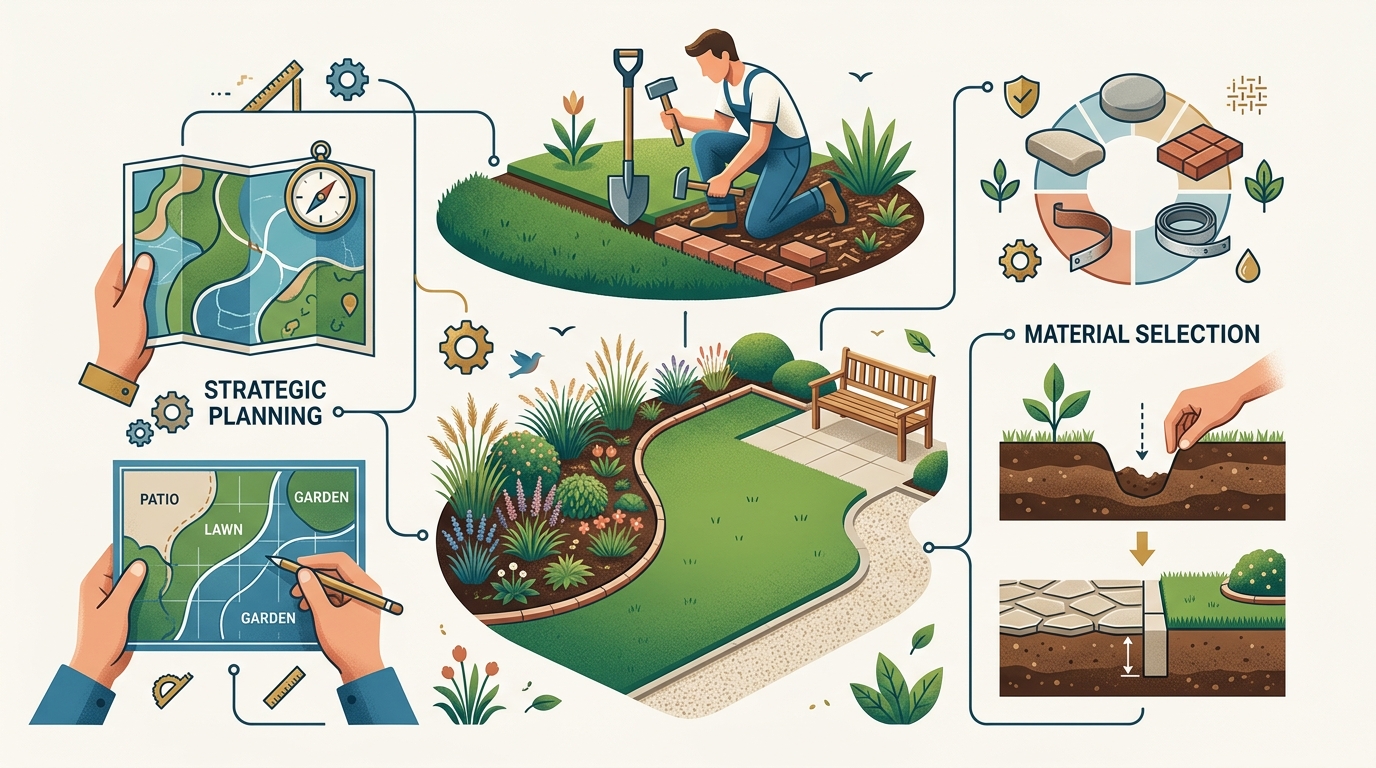
The most effective process is to diagnose the problem, establish a clear outline, and try straightforward corrections before investing in additional materials. When a maintained trench is sufficient, a more elaborate border may add little practical value. When repeated trimming, soil movement, or mulch spillage makes the boundary difficult to manage, a suitable edging material or tool can provide a meaningful improvement.
Purchasing decisions should follow the required function, site conditions, expected lifespan, and total maintenance burden. A flexible border may suit a curved decorative bed, while a more rigid solution may better support a defined transition beside a path. Neither choice is automatically right for every yard, and no ordinary edging material should be expected to solve substantial retaining or drainage problems by itself.
Ultimately, a well-defined backyard is the result of coordinated decisions rather than a single product. Careful layout, restrained excavation, appropriate material use, safe installation, and consistent maintenance work together to preserve crisp boundaries. By correcting the real problem instead of treating every untidy edge as a purchasing opportunity, homeowners can create landscape transitions that remain practical, visually coherent, and easier to care for throughout the seasons.


Comments
Post a Comment